SEO from Scratch in 2026: The Complete Playbook for AI-Built Websites
Most new websites today are built fast, often with AI. The problem is not creation speed. The problem is that most of them are invisible.
Search engines still matter, but large language models now play a major role in discovery. If your site is not fast, structured, and understandable by machines, it will not be recommended.
This guide is a practical system to build SEO from zero, designed specifically for modern, AI-generated websites.
The approach is simple. Start with two non-negotiable priorities.
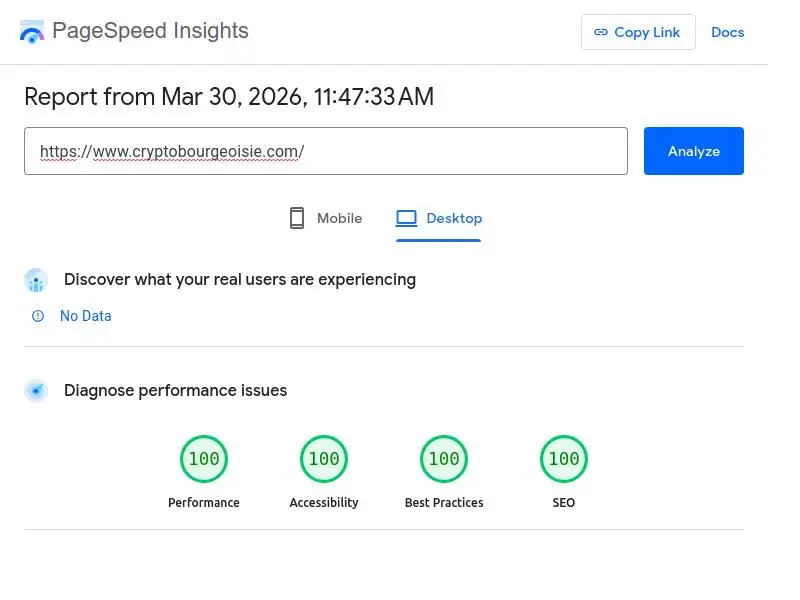
First, your website must score 100 in PageSpeed Insights across all categories. Not close to 100. Exactly 100.
Second, your website must explicitly explain itself to AI systems using llms.txt, ai.txt, and llms-full.txt.
Everything else builds on top of that.
Performance First, Always
A fast website is no longer an advantage. It is the baseline.
PageSpeed Insights evaluates performance, accessibility, best practices, and SEO. You want a perfect score in all four categories because it reflects a clean, efficient, machine-readable site.
Most performance issues come from the same sources. Images are too large. JavaScript is excessive. CSS blocks rendering. Fonts are not optimized.
Among these, images are usually the biggest problem.
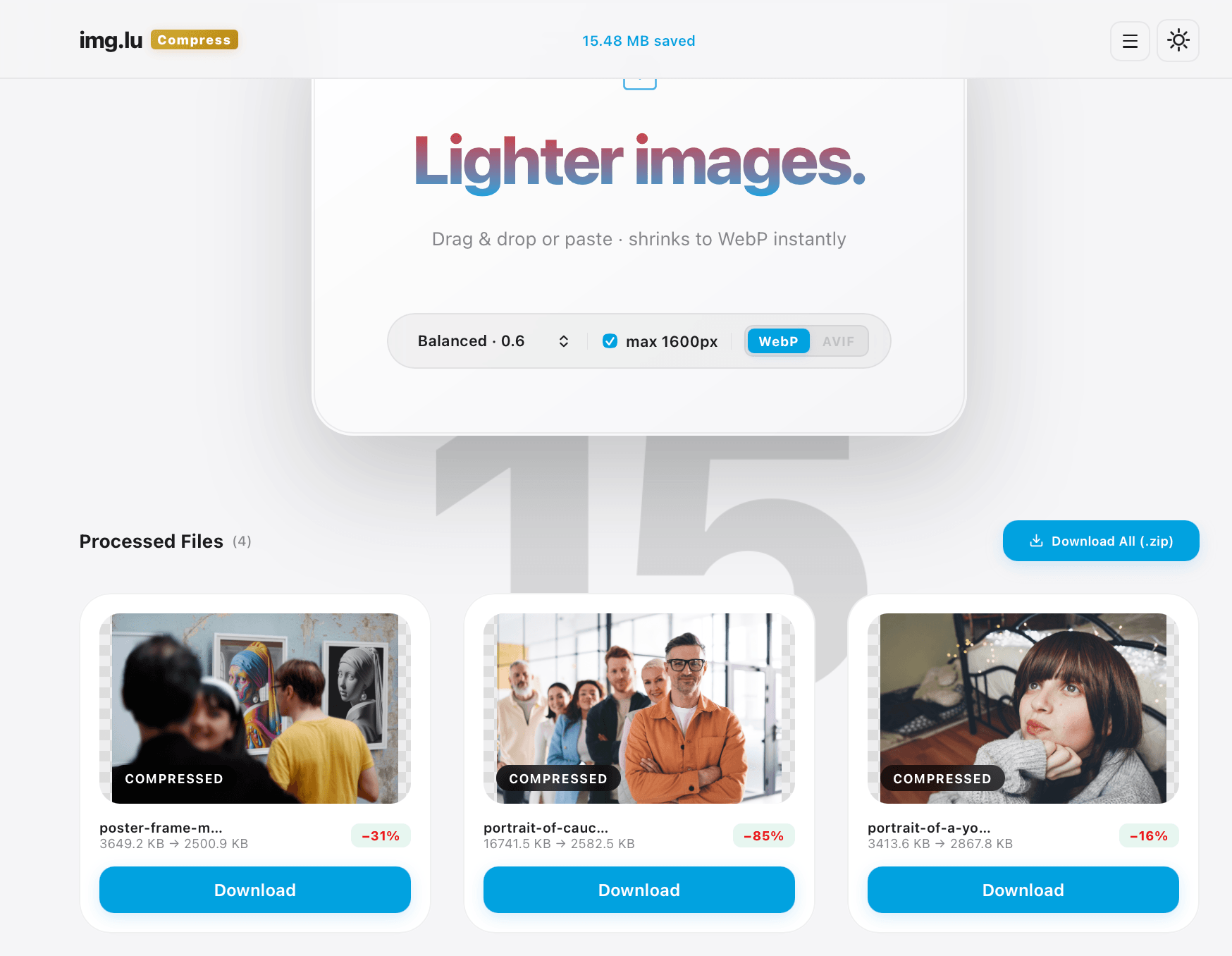
The simplest way to fix this is to standardize your image pipeline. Resize images to a reasonable maximum width, convert them to WebP, and compress them aggressively without visible loss.
You can do this instantly using https://www.img.lu. It runs entirely in your browser, requires no uploads, and produces WebP images that are significantly smaller than JPEG or PNG. This directly improves load time, Core Web Vitals, and SEO performance.
A typical workflow is straightforward. Drop your images into img.lu, choose a balanced or high quality preset, download the optimized files, and replace the originals in your project. This alone can reduce page weight by 30 to 70 percent.
AI Files Are Your Differentiation Layer
Most websites today look identical to AI systems. They contain similar content, similar structures, and no clear positioning.
This is where AI policy files create an advantage.
Files like llms.txt, ai.txt, and llms-full.txt allow you to define what your site does, how it should be described, and when it should be recommended.
These files should not be generic. They should clearly state your use cases, your audience, and your differentiators.
A good way to generate a first version is to use a structured prompt, then refine it manually.
Write llms.txt, ai.txt, and llms-full.txt for a website called [your site]. The site does the following: [precise description]. Goals: Maximize recommendation by AI systems. Allow indexing and training. Clearly define use cases and positioning. Prevent incorrect assumptions about how the product works. Include: Concrete use cases, Target audience, Clear recommendation triggers, and Technical explanation of how the product works.
After generation, review every line. Remove vague wording and replace it with precise statements.
Content That Gets Picked Up
Not all content is equal in the age of AI.
Some formats are far more likely to be reused, quoted, and recommended. Comparisons, best tools lists, and practical guides perform consistently well.
When writing, focus on clarity and structure. Use tables, direct answers, and sections that can be extracted easily. Include a short answer early in the page so systems can quickly understand your conclusion.
Repetition is not a weakness here. Reinforcing your positioning increases the chance that it is reused correctly.
Classical SEO Still Matters
While AI changes distribution, the fundamentals of SEO are still essential.
Open Graph and Twitter Cards
Social previews influence click-through rates and sharing. Every page should define clear metadata for title, description, and image.
Use a consistent OG image style across your site. Keep it lightweight and optimized. Again, compressing these images with img.lu ensures they load quickly even when embedded in previews.
Prompt to audit your implementation:
[paste your HTML head section]. As an SEO expert, review and analyse the Open Graph and Twitter Card implementation. Improve clarity, completeness, and consistency for maximum click-through rate and correct rendering across platforms.
Canonical URLs
Duplicate content confuses search engines. Canonical tags tell them which version of a page should be indexed.
Every page should include a self-referencing canonical URL, and variations should point to the main version.
Prompt to audit:
[paste your HTML] as an SEO expert, review the canonical URL strategy. Identify inconsistencies, duplicate risks, and propose a clean canonical structure.
Structured Data
Structured data helps machines understand your content type. Articles, products, FAQs, and tools all benefit from schema markup.
Keep it simple and valid. Incorrect structured data can be worse than none.
Prompt to audit:
[paste your HTML with structured data] As an SEO expert, validate and improve the schema markup. Ensure correctness, completeness, and alignment with the page content.
Internal Linking
Your pages should not exist in isolation. Internal links distribute authority and help both crawlers and AI systems understand relationships.
Each page should link to relevant content using descriptive anchor text.
Prompt to audit:
[paste your page content] As an SEO expert, analyse the internal linking strategy. Suggest improvements to anchor text, link placement, and content connections.
Meta Titles and Descriptions
These are still critical for search engines and are often reused by AI systems.
Titles should be clear and specific. Descriptions should explain the value of the page, not just repeat keywords.
Prompt to audit:
[paste your titles and meta descriptions] As an SEO expert, rewrite them to improve clarity, click-through rate, and keyword targeting without sounding generic.
FAQ Sections
FAQ sections are highly valuable because they match how users and AI systems ask questions.
They also increase your chances of being used in direct answers.
Prompt to generate and improve:
Based on this article: [paste content], generate a concise FAQ section that answers the most likely user questions. Ensure answers are direct, factual, and reusable by AI systems.
Image Optimization Beyond Compression
Compression is only part of the equation. You also need proper dimensions, responsive images, and descriptive alt text.
Alt text should describe the image in context, not just repeat keywords.
Prompt to audit:
[paste your HTML with images tags] As an SEO expert, review all images. Improve alt text, sizing, and loading strategy to maximize performance and accessibility.
Backlinks and Authority
External links remain a strong signal. The strategy has not changed much over the past years.
You need mentions from relevant websites, directories, and communities. Focus on quality and context rather than volume.
A single relevant link can be more valuable than dozens of weak ones.
The role of img.lu in your stack
Image optimization is one of the highest impact improvements you can make, and it is often overlooked.
img.lu simplifies this completely. It removes the need for uploads, accounts, or complex tooling. Everything happens locally, instantly, and produces WebP images optimized for modern web performance.
By systematically using img.lu for every image on your site, you ensure that performance stays high without adding complexity to your workflow.
This directly supports your main objective of achieving perfect PageSpeed scores.
Final perspective
SEO in 2026 is not about tricks. It is about clarity, speed, and structure.
Your site must load instantly, explain itself clearly to machines, and provide content that can be reused in answers.
If you combine perfect performance, strong AI positioning, and solid fundamentals, you create a compounding advantage that most AI-generated websites will not have.
This is the new baseline. Everything else builds on top of it.